Making Photovoltaic Solar Cells with a Microwave
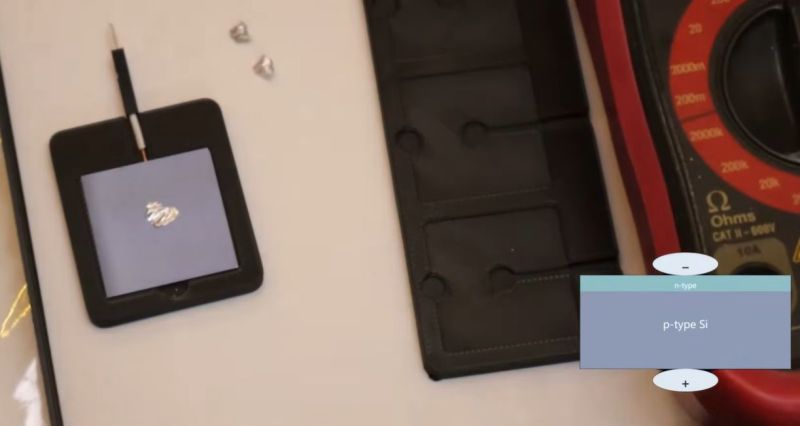
Although solar panels may seem like a kind of magic, they’re really quite simple devices, in their silicon form featuring nothing but the p-type silicon wafer and an n-type layer doped with e.g. phosphorus. Because of this simplicity it’s quite possible to make your own solar cells at home using only a few basic, off-the-shelf ingredients and a kiln, which in this recent video by [Dr. Semiconductor] uses a microwave kiln and thus justifies the video’s title.
Even the silicon wafer that you start with can be easily purchased online, though you have to be careful that it’s a bare wafer, without existing etchings on it. On this you need to get a phosphorus-rich layer, which is done by creating a delicious mixture of 1 mL of tetraethyl orthosilicate (TEOS), 0.3 mL of 85 wt% phosphoric acid, 5 mL of ethanol and 0.25 mL of distilled water. After low heat boiling this for 30 minutes, it is spincoated onto the cut square of silicon wafer using a spinning platform, like a PC fan.
Next, you shove the coated silicon into the kiln and put it into the microwave to bake at a fairly low power level for half an hour. In the video it took less than 50% power of the microwave to not melt the silicon, so remember that those microwave kilns get pretty hot.
With the delightful smells of freshly baked silicon now teasing your nostrils, you can then take out the doped silicon to sand or etch off the thin layer of glass that’s formed around the new PV cell. On the clear spots you can now put a gallium-indium contact on the p-type Si side and a wad of indium on the newly doped Si-P side, which are now your contacts for the PV cell.
The full recipe along with many of the issues discussed in the video can also be found on the blog article, though the video conclusion notes that many improvements are still possible. The created PV cell in the video reaches an efficiency of about 5%, but this could be improved through changes like the use of a clean-room, adding an anti-reflection coating and improving the contact with the cell.
from Blog – Hackaday https://ift.tt/YLl3qW5


Comments
Post a Comment