An Open Source Linear Capacitive Encoder
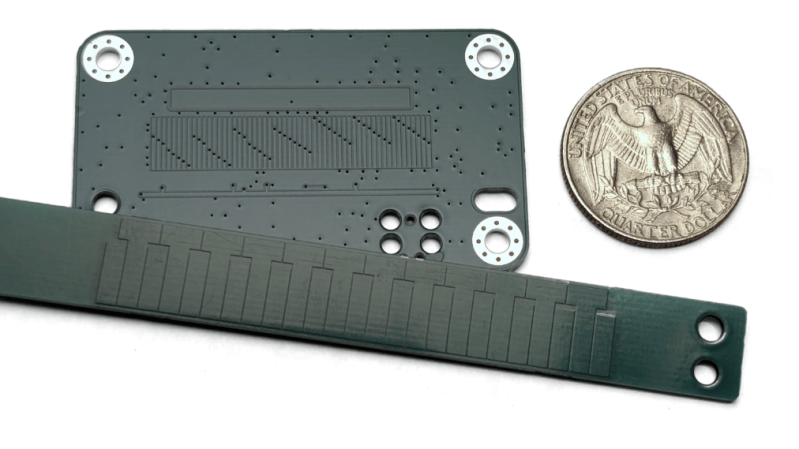
If you’ve ever pulled apart a set of digital calipers, you’ve probably marvelled at the capacitive encoder that does all the measuring work. There’s nothing stopping you from using the same techniques yourself, as [Nick] demonstrates with an open-source capacitive encoder of his own design.
The sensor PCB works by by having a grid of eight transmitting antennas, etched into a PCB, beneath a larger receiving antenna. The transmitting antennas pulse out a pattern as the sensor PCB moves, with the signals bouncing back from the reflector PCB which is fixed in place. The varying capacitance caused by the position of the reflector elements relative to the sensor PCB varies the strength of the pulses hitting the receiving antenna. A microcontroller—in this case an STM32—can read those pulses to determine the displacement of the sensor PCB relative to the reflector down to a very fine degree. In this case, to an accuracy of 40 micrometers. Not bad!
If you need ultra-fine linear tracking for something you’re building, you might find this project very useful. Files are available on Github for the curious, along with a great explainer on exactly how the capacitive coupling becomes a positional reading. You can also study previous teardowns we’ve featured on cheap digital calipers, just to round out your education further. If you’re working on your own impressive workshop equipment, or subcomponents of such things therein, don’t hesitate to let us know on the tipsline!
from Blog – Hackaday https://ift.tt/ZtdTniC


Comments
Post a Comment