Neo-Cyclostyle: Automatic Document Copying Devices in 1890
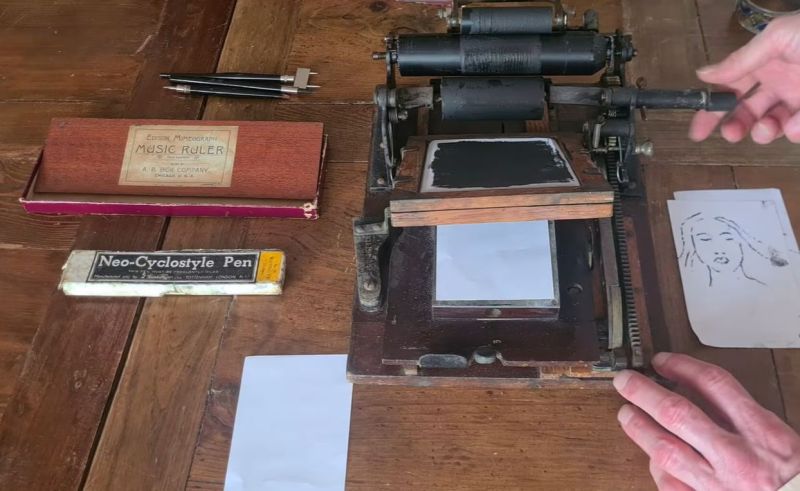

Document duplication has been a highly desirable feature, long before medieval monks slaved over yet another illuminated manuscript by flickering candle light. Fortunately one part of the Industrial Revolution was the invention of machines like Cyclostyle copying machines, which covered a range of manual and automated devices. One such crank-powered device from 1890 is demonstrated in this video.
The Cyclostyle and neo-Cyclostyle copying system was quite simple yet elegant: by removing the wax coating on a special piece of paper ink from a screen-printing system could be pressed through the resulting template, and allow for repeat copies to be made.
With the machine demonstrated in the video the ink is applied to the top rollers, with the lower roller inking itself on them during the retraction cycle, before applying the fresh ink to the screen on the cycle following the insertion of a fresh piece of paper to print on. With this method many copies of the design on the waxed template could be made before it had to be replaced, which would have saved countless hours of work by artists.
After the machine in the video more advanced designs were developed, some of which we covered previously. These would automate more parts of the process, making it faster and more precise, before being replaced by newer technologies.
from Blog – Hackaday https://ift.tt/czGMOsW


Comments
Post a Comment