Taking Polyphony to a New Level
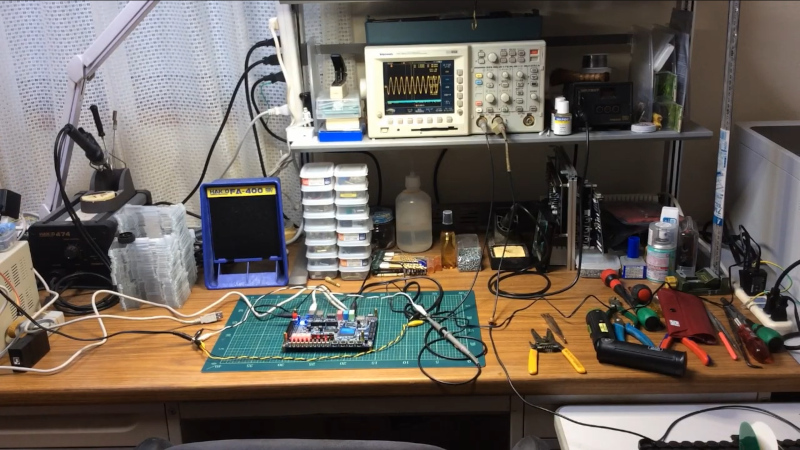
There are all manner of musical synthesis techniques, from the early electromechanical instruments through analogue tape systhesis, the all-electronic waveform synthesisers of the 1960s onwards, and Yamaha’s FM systhesis of the 1980s, to name but a few. One of the attributes of such a machine lies in how many voices it has, or in simple terms, how many notes it can play simultaneously. Electronic complexity limited those early synths, but what happens on an FPGA where vast numbers of circuits can be made with little extra cost? [Tsuneo.Ohnaka] is pushing the envelope a little, by cramming 10240 individually controllable oscillators onto a Terasic DE10-nano FPGA board.
While this thing can in theory generate 10240 different notes at once, in practice that doesn’t mean it has 10240 voices. Instead he calls it a spectrum engine, in that with such a large number of oscillators all with individually controllable frequency, phase, and amplitude, he’s made the part of all those Fourier transform maths where all the different frequencies are combined, in hardware. It’s as though you had a sound card which wasn’t based around a DAC fed with samples, instead all those spectrum points you’d derive from a Fourier transform. Because it’s a massive parallel array of real oscillators it all happens concurrently, instantaneously in real time, and is not held back by the processing constraints of a microprocessor. Think of it as something akin to a software defined radio transmitter, but for the world of audio synthesis.
In that light, it can emulate all those other forms of audio synthesis driven by software, but without the software overhead of generating the waveforms. It’s certainly a different approach to generating audio from a computer, and he’s posted a cacophonic demo video below of it as an 80-voice polyphonic synthesiser. We like it.
from Blog – Hackaday https://ift.tt/kd6JXo5


Comments
Post a Comment