How to Let Everyone Keep a Secret
Someone calls you at work and says, “Don’t tell anyone, but…” If you are like most people, there are one or two people you will pass it along to with the same admonishment. In fact, they are probably repeating it from someone else, and you are on their list of two people. So for really big secrets, you need a way to spread the secret out so that no one has any real information about the secret, but a certain number of people together can decode it. As [neeaj] explains in a recent post about Shamir’s Secret Sharing, [Adi Shamir] (the S in RSA encryption) devised a way to do this very well in 1979, and the core concept is very easy to understand.
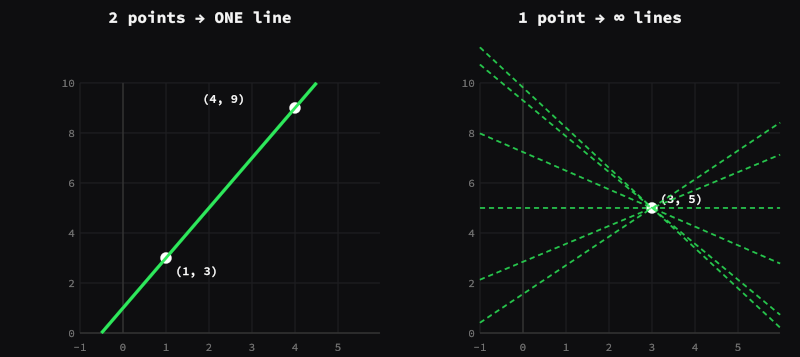
The explanation works with geometry. The equation for a line is y=mx+b, where m is the slope and b is the y-intercept (that is, where the line touches the y-axis when X is 0. An infinite number of lines cross the Y axis at, for example, 10. The line y=3x+10 does, and so does the line y=-1.41x+10. You can’t guess the b value from just the slope, because any slope will satisfy the equation.
So suppose the secret number is 10. I can pick a random slope and generate points on it. Like the y-intercept, any number of equations might satisfy that point. Let’s pick a random slope of 2 just to make the math easy. Our real equation is y=2x+10. Let’s pick a random X of 100 and tell one person their part of the secret is (100,210). That matches our equation, of course, but it also matches y=4x-190 and y=x+110, along with an infinite number of other lines.
To know the actual equation, you need at least two points. So let’s pick x=25 and tell another person that their part of the secret is (25,60). Now, if those two people compare notes, you can find the secret number by solving the two equations:
210=100m+b and 60=25m+b
The second equation is the same as 240=100m+4b, and you can subtract the first one from that:
30=3b
10=b
You can hand out any number of points to any number of people. Any two of them can recover the secret number. If you need to require more people to unlock the secret, you just go up in order. A parabola equation, for example, requires three points. A cubic takes four, and so on.
In reality, practical implementations take a polynomial, not a graph. But the elegant idea is the same. Not the first time we’ve heard of this algorithm. Reminds us of how a nuclear launch requires multiple keys.
from Blog – Hackaday https://ift.tt/mbZ7WI0


Comments
Post a Comment