Keebin’ with Kristina: the One With the NEO With the Typewriter Shell

Isn’t this glorious? If you don’t recognize what this is right away (or from the post title), it’s an AlphaSmart NEO word processor, repackaged in a 3D-printed typewriter-esque shell, meticulously designed by the renowned [Un Kyu Lee] of Micro Journal fame.
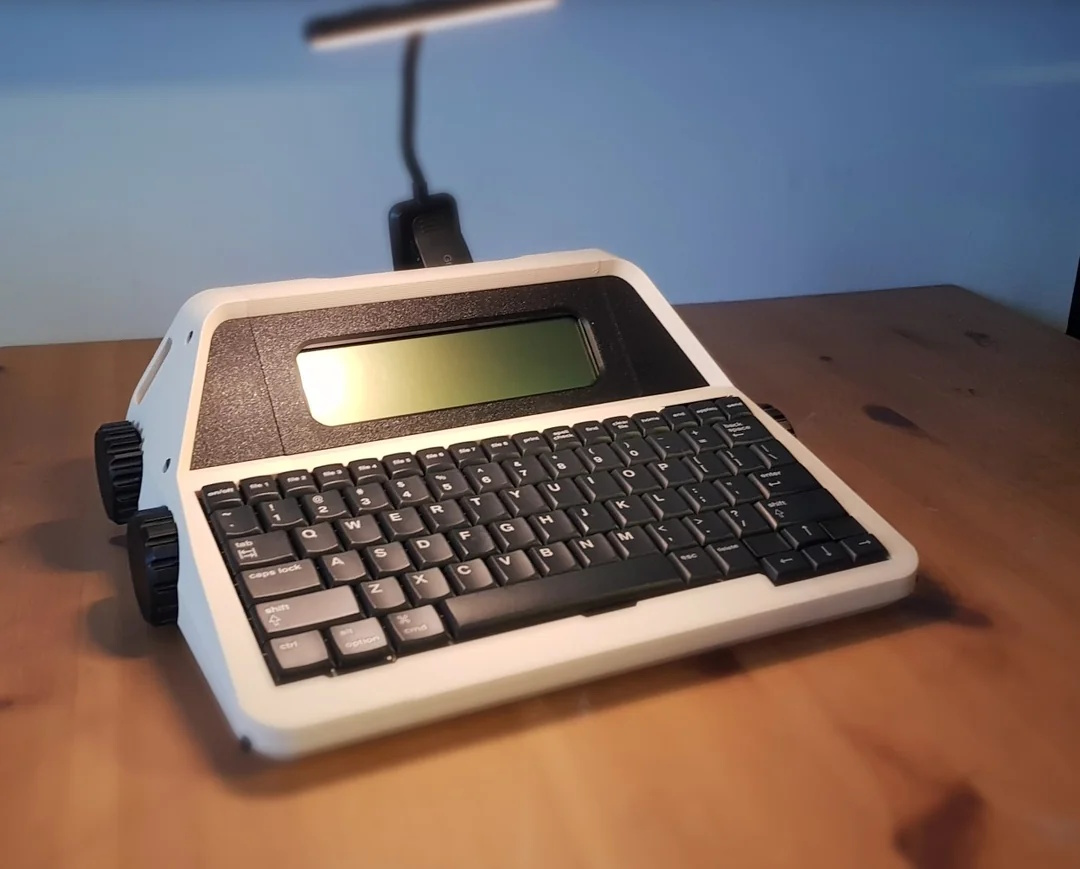
Assembly looks easy enough; there’s no soldering, but you do have to disconnect and reconnect the fiddly ribbon cables. After that, it’s just screws.
This design happened by accident. A friend named [Hook] who happens to manage the AlphaSmart Flickr community had given [Un Kyu Lee] a NEO2 to try out, but before he could, it fell from a shelf and the enclosure suffered a nasty hole near the screen. But the internals seemed fine, so he got the idea to design a new enclosure.
I don’t believe the knobs do anything, but they sure do look nice. There’s an area along the top where you can clip a light, since the NEO has no backlight. There are also two smaller slots on the sides if your light won’t clip to the top.
I’d really like to do this to one of my NEOs. I have two NEO regulars, but reviewers on Tindie report that it works just as well with those as the NEO2.
IBM 701c Butterfly Keyboard Flaps Its Wings Again
I feel like this wonderful laptop and its butterfly keyboard come up often enough, but for today’s lucky 10,000, the IBM 701C laptop has a sweet keyboard that automatically extends when the lid is opened, kind of like one of those special birthday cards.
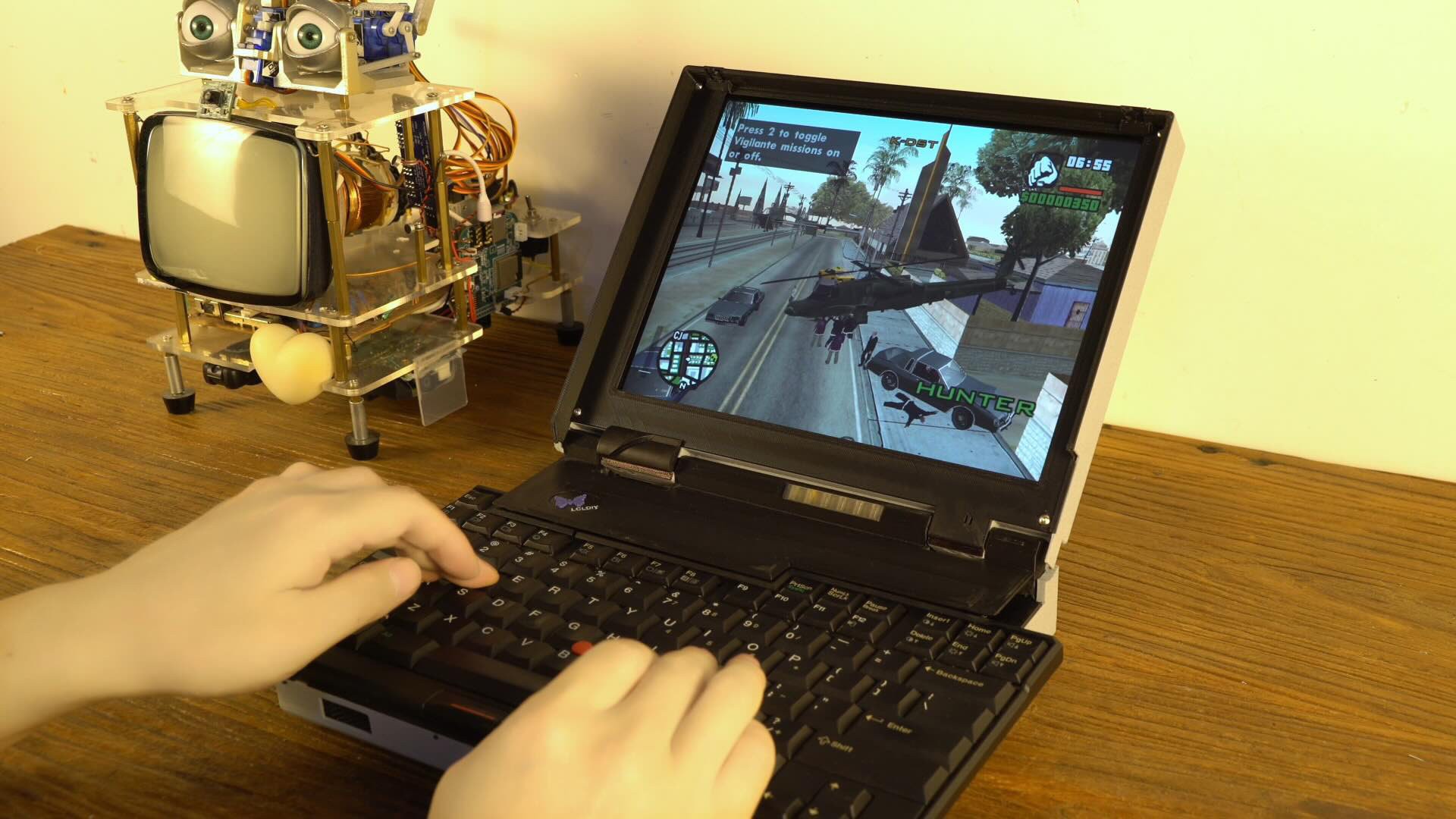
First, he obtained a replacement screen and motherboard, and set about modeling a new case. Be sure to watch the video below so you can catch the machine [LCLDIY] does his modeling on. Now, here’s a surprise: the filament is all hand-spun from plastic bottles he collected from the streets.
Once the case was done, he ran into a slight problem. Namely, the keyboard has a ribbon cable and not a USB interface, so he had to make a PCB to handle that and get it over to the motherboard. Really, [LCLDIY] did so much more than save a keyboard; he built an entire laptop around it. To that, I say kudos. Kudos from Kristina.
The Centerfold: the Smurve80 Is a Thing You Could Buy
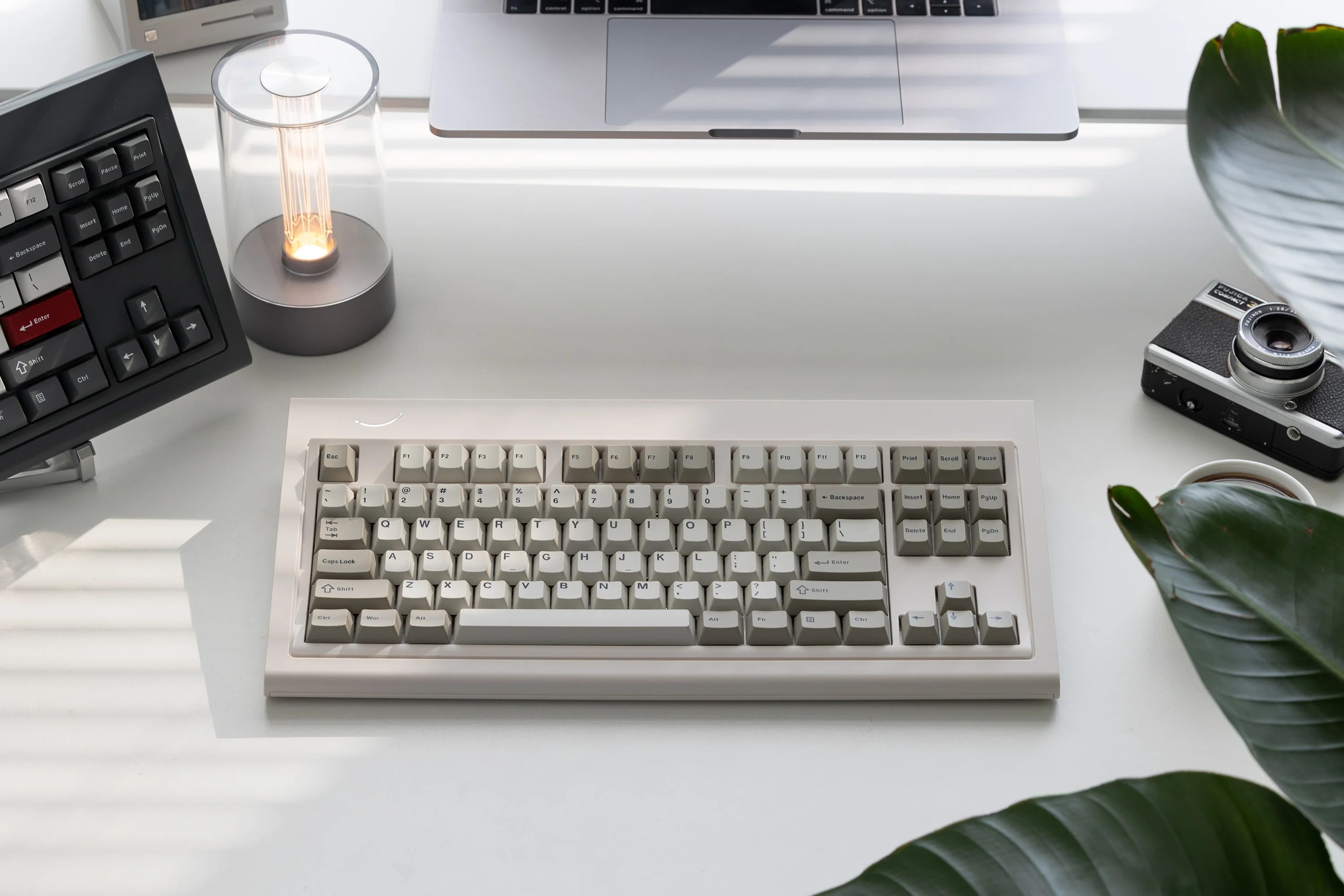
What is this? A baby Model M? A Unicomp? Neither — it is the Smurve80 from Play Keyboard x Swagkeys. This 87-key TKL is heavily inspired by the Model M, however, down to the curved keyboard. And the name? It’s an amalgamation of ‘smile’ and ‘curve’, and this is reflected in the unfortunately Amazon-like logo in the upper left. I might get one anyway. I haven’t decided. If I do, you can bet I will probably be reviewing it.
Here’s the full info post, and here’s the post about the group buy, which is live now (NA link) through February 16th at 10PM ET. Not in North America? Check the group buy post for a list of vendors. For a mere $100, this baby can be yours in either Sandstone (pictured) or Graphite (semi-pictured), and that’s the fully assembled price. There’s also a bare-bones kit version. The best part, aside from the price, has to be the built-in solenoid. So you can get it with reds if you want, but it’s gonna be loud regardless. Just kidding; you can switch off the solenoid.
Do you rock a sweet set of peripherals on a screamin’ desk pad? Send me a picture along with your handle and all the gory details, and you could be featured here!
Historical Clackers: the Wellington
Are you familiar with Wellington Parker Kidder? His name is nearly as one with typewriter history as Christopher Latham Sholes (the guy responsible for QWERTY). I myself had not heard of Kidder, but his name is directly and indirectly associated with dozens of machines, including the Franklin, the Rochester, and the Noiseless, which was later bought by Remington. Then there’s all the clones of his work.
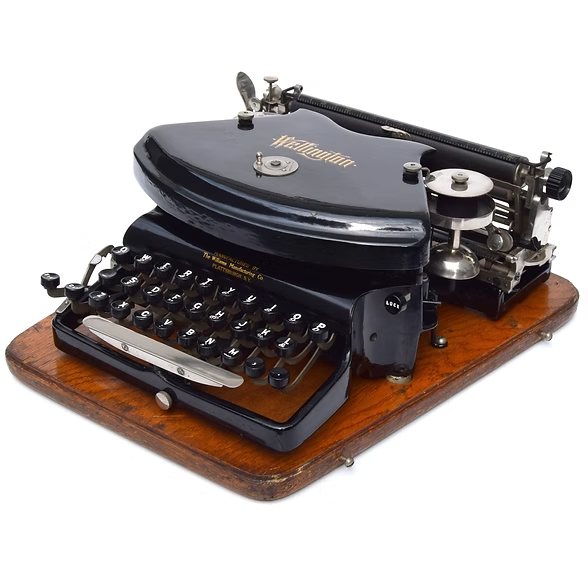
Kidder’s patents for the Wellington first appeared in 1892. The appeal of this machine is in the thrust-action type bars, which punch the platen rather than swinging to strike it. The design was well-received, and the Wellington was produced virtually unchanged from 1892 to 1924.
There were two models, No. 1 and No. 2. The former had square key tops, while the latter featured rounded key tops. Both models had a three-row keyboard with a double-shift mechanism, and used an extra-wide ribbon. They also both had that attractive cover on the type bars that reminds me of the fender skirts on, say, a 1950 Mercury.
And much like that 1950 Mercury, Wellingtons were well-built, but unfortunately the passage of time has proven them to be rust buckets. That’s really sad to me and I wish I could forget the fact.
The Wellington sold well enough in the States, but it really shone in Europe. Many typewriters are based on the either the overall design, or at least the type bar mechanism. Antikey Chop calls Kidder’s Wellington one of the most influential typewriters of all time, and I believe it.
Finally, the Zerowriter Is Shipping For Early Backers
In case you don’t have an AlphaSmart NEO and/or dislike the Freewrite for whatever reason, there’s also the Zerowriter, created by a one-man team out of Canada. You can pre-order it today for $279 and it’ll ship March 30th for free, worldwide.
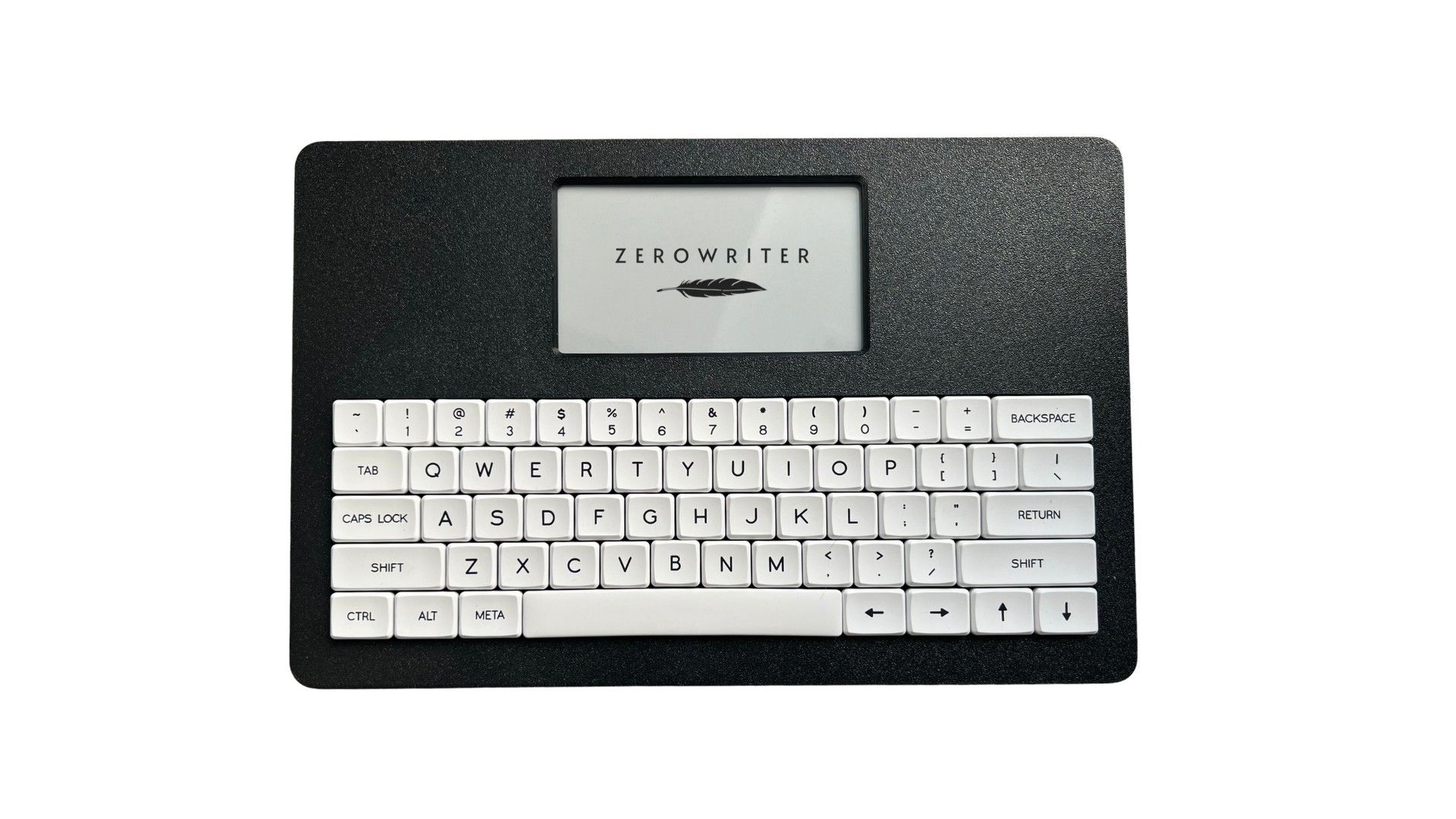
So, what is this thing? It’s a distraction-free writing tool with an e-ink screen and a low-profile mechanical keyboard. The battery is supposed to last a long time, and it’s cheaper than a Freewrite.
This thing has Kailh Choc Pro red switches, which are thankfully hot-swappable. Much like the NEO, it comes on and is instantly ready for typing. There’s no account to register, no login to memorize. Files are saved as .txt to a microSD card and can be transferred to a computer, though unlike the NEO, there’s a companion app standing between you and file transfer.
That said, this baby uses an ESP32 and was coded in Arduino, so do what you will. The battery is supposed to last for weeks of daily use on a single charge. It’s a user-replaceable LiPo pouch with USB-C charging. They actually encourage you to open her up, and I think that’s great.
Got a hot tip that has like, anything to do with keyboards? Help me out by sending in a link or two. Don’t want all the Hackaday scribes to see it? Feel free to email me directly.
from Blog – Hackaday https://ift.tt/3p05caN


Comments
Post a Comment