Adding a Panadapter to a Classic Receiver
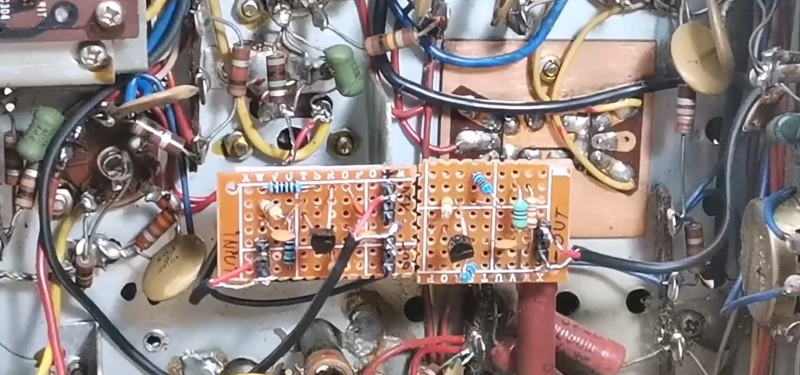
There was a time when only the richest ham radio operators could have a radio with a panadapter. Back in the day, this was basically a spectrum analyzer that monitored a broad slice of the receiver’s intermediate frequency so you could see signals on either side of the receiver’s actual frequency. Today, with SDR technology and computers, this is an easy thing for receivers to implement. But what if you want to refit a classic radio? It isn’t that hard, and [Mirko Pavleski] shares his notes on how he tackled the project. You can also check it out in the video below.
The plan is simple. A FET amplifier taps the radio’s IF stage before the first IF filter. This provides good isolation and buffering. Then, an emitter follower stage provides a matched output to the SDR through a low-pass filter. The SDR remains tuned to the IF frequency, of course. The rest is essentially software and procedures.
Of course, your exact connection to your radio will differ unless you have the same receiver shown in the video. A modern scope with an FFT should be able to help you quickly locate a good spot, though.
Of course, you could just listen through the SDR, but that doesn’t seem sporting but that’s what it looks like he does in the demonstrations. Essentially, he’s using the radio’s RF system via the first IF mixer, then letting the SDR handle the rest. But you could just use the display and tune the radio instead.
If you really wanted a cool system, you could frequency count the internal frequencies and display the correct frequencies in software. Then you could also track the current frequency. This would make it seem more like a traditional panadpater and less like just replacing most of the radio’s features with an SDR.
We’ve seen these before, of course. Many times.
from Blog – Hackaday https://ift.tt/Jcq1rHu


Comments
Post a Comment